APPS • DAILYTECH.ID - In Google Docs, the Find and Replace function is accessed by pressing Ctrl+H (Windows/Chrome OS) or Cmd+Shift+H (Mac), or via the Edit menu. Enter the text you wish to find, enter the replacement text, and select “Replace” for individual instances or “Replace all” for global changes. This tool is essential for quickly correcting errors and ensuring consistency across large documents.
The core process of executing a find and replace function in Google Docs involves locating the tool and executing the search parameters efficiently. Understanding both the basic execution and advanced options ensures maximum productivity when dealing with extensive documents, whether you are managing technical specifications, editing a novel, or finalizing a crucial business report.
How to Access and Activate Find and Replace in Google Docs
The ability to quickly locate and open the Find and Replace dialog box is the first step toward efficient bulk editing. Google Docs provides multiple ways to activate this feature, ensuring that regardless of your preferred workflow—keyboard-driven or menu-driven—you can instantly access the tool.
Keyboard Shortcuts for Instant Access (Mac, Windows, and Chromebook)
For power users managing extensive documents, understanding the specific keyboard shortcuts is paramount. Utilizing these shortcuts allows you to bypass the navigation menus entirely, instantly activating the Find and Replace dialog box on any platform, significantly accelerating your editing workflow.
- Windows and Chrome OS: To instantly activate find and replace in Google Docs on a PC or Chromebook, press Ctrl + H.
- Mac OS: Users on Mac computers need to use a slightly different combination: Cmd + Shift + H.
Memorizing this shortcut (which often appears as a combined “Search and Replace” function) ensures you can immediately open the necessary dialogue box to begin defining your search parameters. This method is the fastest way to get to find and replace in Google Docs, regardless of the document’s size.
Locating the Feature via the Edit Menu
If you are new to the platform or prefer navigating via the standard menu structure, you can easily find and replace in Google Docs using the top navigation bar.
- Locate and click the Edit menu, positioned near the left side of the main menu ribbon.
- Scroll down the dropdown list until you see the option labeled Find and replace.
- Clicking this option will open the exact same dialogue box accessed via the keyboard shortcut, allowing you to proceed with your text substitutions.
This method confirms that you can always access the function, answering the question of where to find find and replace in Google Doc even if the shortcuts slip your mind.
Step-by-Step Guide to Basic Find and Replace
Once the dialog box is open, the process of executing a basic search and replace operation is straightforward, but careful execution is key to avoiding unintended consequences.
Defining the Function: What Does Find and Replace Do?
At its core, the Find and Replace function is a utility that allows the user to search the entire body of text for a specific sequence of characters (a word, phrase, punctuation mark, or even a space) and substitute every instance of that sequence with a different defined sequence. This substitution can be performed one instance at a time or globally across the document. This is critical for tasks such as updating old terminology, correcting a repeatedly misspelled name, or standardizing citation format throughout a scholarly paper.
Executing Single and Global Replacements
This section outlines the standard steps for how to use find and replace on Google Docs for both granular and widespread changes.
- Open the Dialog: Activate the tool using the shortcut (
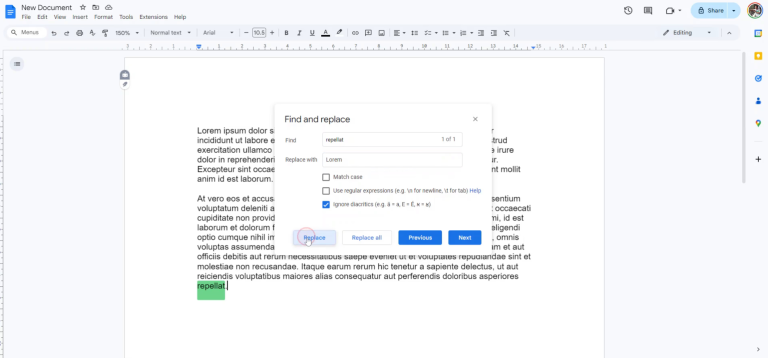
Ctrl+HorCmd+Shift+H) or the Edit menu. - Enter the Target Text: In the top field, labeled “Find,” type the exact word or phrase you wish to change.
- Enter the Replacement Text: In the bottom field, labeled “Replace with,” type the new word or phrase that should substitute the target text.
- Review and Execute:
- Find (Next/Previous): Click the forward or backward arrows to cycle through each instance of the target text in the document. This allows you to verify the context before replacement.
- Replace: Click this button to change the currently highlighted instance only.
- Replace All: Click this button to do a search and replace in Google Docs across every single instance of the target text simultaneously. Use this option judiciously, especially in large documents, as it can be difficult to audit the changes afterward.
Knowing how to find and replace all in Google Docs quickly is vital for efficiency, but always ensure your search parameters are precise before initiating a global change.
Advanced Search Settings: Match Case and Regular Expressions
The Find and Replace dialogue box includes optional toggles that significantly enhance the power of your search operation, moving beyond simple word-for-word substitution. This is how to use advanced find and replace in Google Docs effectively.
Match Case
This toggle forces the search engine to be case-sensitive. If you check “Match Case” and search for “apple,” the tool will only find “apple” and ignore instances of “Apple” (capitalized) or “APPLE” (all caps). This is essential when correcting capitalization errors or when the difference between an acronym and a standard word depends entirely on the case.
Regular Expressions (RegEx)
Regular expressions are a specialized sequence of characters that define a complex search pattern. Checking the “Use regular expressions” box transforms the power of the tool, allowing you to search for patterns rather than exact literal text.
- Searching for Specific Patterns: You can use RegEx to find things like all numbers followed by a period (
\d\.), text inside parentheses (\((.*?)\)), or instances where a word is repeated. - Replacing Complex Patterns: RegEx also allows you to reference the text found within the pattern (known as capturing groups) and reuse it in the replacement field. For instance, if you want to swap the order of first and last names separated by a comma, RegEx makes this possible in a single global operation.
Mastering regular expressions significantly increases the utility of the Find and Replace function for technical writers and editors dealing with highly structured data or inconsistent formatting.
Advanced Techniques for Text and Formatting Replacement
While the basic substitution is powerful, many bulk editing tasks require addressing non-visible characters or formatting attributes, which require specialized approaches in Google Docs.
Searching for Special Characters (New Lines and Tabs)
Invisible characters, such as hard line breaks, paragraph breaks, or tabs, often lead to inconsistent spacing and formatting issues in large documents imported from external sources. To handle these, you must rely on the regular expressions feature.
To find and replace enter in Google Docs, you need to use the standard RegEx conventions for these characters:
- New Line Character (Line Break): Use
\nin the Find field. This is used to find instances where text jumps to the next line without starting a new paragraph (often inserted by pressing Shift+Enter). - Tab Character: Use
\tin the Find field. This helps standardize indentation created by inconsistent tab stops. - Carriage Return (Paragraph Break): Use
\rin the Find field. This is most often used to target standard paragraph breaks.
By searching for these codes and replacing them with a single space or standard paragraph break, you can normalize the document’s vertical spacing quickly.
How to Find and Replace Formatting Attributes
This is one of the most frequently asked questions, as users often seek to perform bulk changes on attributes like bolding or italics, much like they might in dedicated desktop word processors.
Crucial Limitation: The standard, built-in Google Docs Find and Replace dialog (accessed by Ctrl+H) does not natively include fields to search for or replace formatting attributes (e.g., “Find all bold text” or “Replace italics with strikethrough”). The tool operates strictly on the text characters themselves.
The Workaround for Formatting
If you need to isolate and modify text based solely on formatting (how to find and replace bold in Google Docs, or how to find and replace italics in Google Docs), you must employ one of two methods:
- Manual Search and Replace (Using Find): You can open the standard Find tool (
Ctrl+ForCmd+F). Unlike the Replace tool, the Find tool does highlight text that matches the formatting of your cursor location. However, this only helps you locate the instances; you still must manually apply the replacement formatting and text. - Using Add-Ons: For true bulk formatting manipulation (e.g., changing all instances of
SuperscripttoSubscript), you must utilize a third-party Google Workspace Add-on. Tools like “Docs Utilities” or specialized formatting add-ons provide the robust search criteria needed to target formatting styles like bold, italic, superscript, or specific font types and sizes.
When asked how to find and replace superscript in Google Docs universally, the efficient answer lies outside the core Find and Replace function and within the powerful, often free, add-on ecosystem.
Using Find and Replace Across Different Platforms
The core functionality of Find and Replace remains consistent, but accessing the tool differs slightly depending on whether you are using a full desktop browser or a mobile device.
Navigating the Google Docs Mobile App (iOS and Android)
Performing bulk edits on a smaller screen requires knowing exactly where to locate the tools, as the interface is streamlined compared to the desktop version. This addresses how to find and replace in Google Docs mobile/iPad.
- Open the Document: Launch the Google Docs app and open the document you wish to edit.
- Access the Menu: Tap the three-dot menu icon (usually found in the top right corner of the screen).
- Select the Function: In the resulting menu, look for the option labeled Find and replace.
- Execution: The familiar two-field dialog box will appear at the bottom of the screen. Enter your search and replacement terms. Use the small arrows to navigate between instances and select the “Replace All” option as needed.
The workflow is identical to the desktop version, ensuring that you can maintain consistency even when editing on the go (e.g., how to find and replace in Google Docs on iPad).
Platform Differences: Docs Find and Replace on Mac vs. PC
While the overall functionality is platform-agnostic, the only significant difference between using Docs Find and Replace on Mac versus a PC (Windows/Chromebook) is the keyboard command required to open the dialog box.
- PC/Chromebook: Uses the
Ctrlkey (Ctrl+H). - Mac: Uses the
Commandkey, combined with theShiftkey (Cmd+Shift+H).
The interface, advanced settings (Match Case, RegEx), and the execution buttons (Find, Replace, Replace All) are exactly the same across all operating systems when utilizing the browser version of Google Docs. This consistency ensures a seamless transition for users who switch between devices.
Extending Your Efficiency: Find and Replace in Google Sheets and Slides
The usefulness of the Find and Replace tool extends beyond text documents into Google’s other productivity suite applications, offering standardized methods for bulk data cleanup and consistency checks.
Applying Find and Replace Principles in Google Sheets
In Google Sheets, the Find and Replace function is critical for cleaning up structured data, fixing errors in formulas, or standardizing cell inputs. The function is accessed similarly:
- Access: Use the shortcut (
Ctrl+HorCmd+Shift+H) or navigate to Edit > Find and replace. - Functionality Nuance: The Sheets dialog box includes additional options not present in Docs:
- Search: You can select whether to search “All sheets,” the “Current sheet,” or a “Specific range.”
- Look in: Crucially, you can specify whether the search should target the text within the cell values (the displayed result) or within the underlying formulas. This allows you to update function names or cell references in hundreds of formulas simultaneously.
- Include formula search: This checkbox is essential for technical users who need to perform structural corrections across a massive spreadsheet of calculations.
Knowing how to use find and replace in Google Sheets is invaluable for anyone managing data sets.
Quick Overview for Google Slides
The Find and Replace tool also exists within Google Slides. Its primary purpose here is to ensure textual consistency across a large presentation, such as correcting branding terminology or fixing a repeated typo that appears on multiple slides.
- Access: As with Docs and Sheets, use the standard shortcut or go to Edit > Find and replace.
- Scope: The function automatically searches all text boxes across every slide in the presentation.
Although less complex than its counterpart in Sheets, knowing how to use find and replace in Google Slides ensures that every viewer sees consistent, polished text.
Troubleshooting and Error Correction
Even the most careful editors sometimes execute a “Replace All” command only to realize a crucial mistake was made, perhaps replacing a common article like “the” with unintended text because the “Match Case” feature was forgotten. Immediate recovery is usually possible.
How to Undo a Global Find and Replace
If you realize immediately after clicking “Replace All” that you have made a mistake, the solution is straightforward and universal across almost all computing platforms: the Undo function.
- Immediately Use the Shortcut: Press Ctrl+Z (Windows/Chrome OS) or Cmd+Z (Mac). This command immediately reverses the last action taken, which, in this case, is the global replacement operation.
- Use the Menu Button: Alternatively, click the Undo Arrow icon on the top toolbar (the left-pointing curved arrow).
Google Docs tracks your history precisely. Executing the Undo function will reverse the entire batch of substitutions executed during the “Replace All” command, restoring your document to its state before the mass change. This answers how to undo find and replace in Google Docs safely. If you wait too long or perform subsequent actions, you may need to rely on the version history feature for full recovery.
FAQs – How to Use Find and Replace in Google Docs
The fastest keyboard shortcut to open the Find and Replace dialog box on a Windows PC or a Chromebook is Ctrl + H. This instantly activates the tool, allowing you to begin defining your search and replacement terms without navigating through the Edit menu.
The standard built-in Find and Replace tool (Ctrl+H) in Google Docs only searches for character strings, not formatting attributes. To perform bulk replacement based on formatting (like bold or italics), you must rely on advanced Google Workspace Add-ons designed for document cleanup.
To search for all instances of a word and replace them simultaneously, input your target word in the “Find” field and the new word in the “Replace with” field. Then, click the Replace All button within the Find and Replace dialog box to execute a global change instantly.
Yes, the Find and Replace function is fully available on the Google Docs mobile app (iOS and Android). You can access it by opening your document, tapping the three-dot menu icon in the upper right corner, and selecting Find and replace from the list of options.
If you accidentally click “Replace All,” immediately use the Undo function to reverse the change. The quickest way is to press the keyboard shortcut Ctrl+Z (Windows) or Cmd+Z (Mac). This action reverses the entire batch operation performed by the mass replacement command.